Each kidney is held in place by connective tissue, called renal fascia, and is surrounded by a thick layer of adipose tissue, called perirenal fat, which helps to protect it..
In respect to this, what is the filtering unit of the kidney?
Each of your kidneys is made up of about a million filtering units called nephrons. Each nephron includes a filter, called the glomerulus, and a tubule. The nephrons work through a two-step process: the glomerulus filters your blood, and the tubule returns needed substances to your blood and removes wastes.
Additionally, what is the cortex of the kidney? The renal cortex is the outer portion of the kidney between the renal capsule and the renal medulla. In the adult, it forms a continuous smooth outer zone with a number of projections (cortical columns) that extend down between the pyramids. The renal cortex is the part of the kidney where ultrafiltration occurs.
where is the lower pole of the kidney?
The kidneys are paired retroperitoneal structures that are normally located between the transverse processes of T12-L3 vertebrae, with the left kidney typically somewhat more superior in position than the right. The upper poles are normally oriented more medially and posteriorly than the lower poles.
In what part of the kidney are the renal pyramids located?
The renal papilla is the location where the renal pyramids in the medulla empty urine into the minor calyx in the kidney.
Related Question Answers
What is the first sign of kidney problems?
Early signs of kidney failureIf you experience early signs of kidney disease, they may include: decreased urine output. fluid retention that leads to swelling in limbs. shortness of breath.How do I keep my kidneys healthy?
Keeping your kidneys healthy Healthy body - Stay hydrated. Drinking plenty of fluid will help your kidneys function properly.
- Eat healthily. A balanced diet ensures you get all the vitamins and minerals your body needs.
- Watch your blood pressure.
- Don't smoke or drink too much alcohol.
- Keep slim to help your kidneys.
What waste does the kidney remove?
The kidneys are the filtering devices of blood. The kidneys remove waste products from metabolism such as urea, uric acid, and creatinine by producing and secreting urine. Urine may also contain sulfate and phenol waste and excess sodium, potassium, and chloride ions.Can you live without kidneys?
People may be born with just one kidney, or have one removed after injury or for a donation. In general, people with one kidney have few or no health problems, and have a normal life expectancy, according to the National Kidney Foundation. Technically, people can live with no kidneys, but require dialysis.Do kidneys remove toxins?
Our filtering organs, i.e. the kidneys and liver, remove toxins from our bodies daily, allowing us to safely eliminate them. When your kidneys are functioning properly, they filter 120 to 150 quarts of blood every day and produce one to two quarts of urine. They prevent waste and excess fluid from building up in cells.Why does the kidney filter blood?
Your kidneys act like a filter to remove wastes and extra fluid from your body. Your kidneys filter about 200 quarts of blood each day to make about 1 to 2 quarts of urine. The urine contains wastes and extra fluid. This prevents buildup of wastes and fluid to keep your body healthy.How much blood does the kidney filter per day?
The kidneys filter about 50 gallons of blood a day. Of that amount, about one-half to two quarts of fluid and waste products are removed from the blood and passed out of the body in urine.What does the kidney filter from blood?
The kidneys' job is to filter your blood. They remove wastes, control the body's fluid balance, and keep the right levels of electrolytes. All of the blood in your body passes through them several times a day. Blood comes into the kidney, waste gets removed, and salt, water, and minerals are adjusted, if needed.What is the anatomy of the kidney?
Gross AnatomyThe urinary system of the human body consists of two kidneys, two ureters, the bladder and a single urethra. The kidneys are located on the posterior wall of the abdomen at waist level. Each kidney is roughly 10 cm long and 5 cm wide, and is encased in a fibrous outer capsule called the renal capsule.What is the normal size of kidneys on ultrasound?
The length of the adult kidney is normally 10–12 cm, and the right kidney is often slightly longer than the left kidney [3,5]. The adult kidney size is variable due to the correlation with body height and age [3,5,6,7]; however, normograms for pediatric kidney size are available [7,8,9].What is the position of kidney?
The kidneys are bean-shaped organs (about 11 cm x 7 cm x 3 cm) that are located against the back muscles in the upper abdominal area. They sit opposite each other on both the left and right side of the body; the right kidney, however, sits a little lower than the left to accommodate the size of the liver.Why is the right kidney lower than the left kidney?
The right kidney is usually lower than the left kidney because of the location of the liver. The kidneys usually extend from the level of the Th12 to L3 vertebrae, and are slightly lower in females.What is kidney calyx?
Anatomical terminology. The renal calyces are chambers of the kidney through which urine passes. The minor calyces surround the apex of the renal pyramids.How much do kidneys weigh?
WEIGHT OF NORMAL ADULT KIDNEYSHAUCH 1901) found the right kidney to weigh on the average 141 g. and the left kidney 152 g. in males, as compared with 115 g.What is a normal kidney size?
The size of the kidneys is measured mainly sonographically, although both CT and MRI scans also can be used to estimate kidneys size. The average length pole to pole (LPP) of an adult human kidney is 10-13cm (4 to 5 inches). In general, left kidney is slightly longer than the right.Do lower pole kidney stones cause pain?
With that said, there is no question that the pain associated with frequent stone passage can have a major impact on a person's life. never_ever: My doctor told me that kidney stones CANNOT cause pain until they drop into the ureter. I have a 9mm stone in the lower pole of my left kidney and severe flank pain.Where in the kidney does urine concentration occur?
Maximum concentration occurs at the bottom of the loop. The ascending limb of the nephron loop is impermeable to water, but Na + and Cl – are pumped out into the surrounding fluids by active transport. As fluid travels up the ascending limb, it becomes less and less concentrated because Na + and Cl – are pumped out.What is difference between liver and kidney?
Liver – your liver is the organ below the lungs that acts like a filter for the blood. The liver is the only internal organ that can regrow. Kidneys – the kidneys are also filters. Some drugs are filtered more by the kidneys than by the liver.Is cyst on kidney serious?
Most simple kidney cysts are harmless and don't cause problems. If a cyst grows, sclerotherapy or surgery can remove it without any long-term complications. Polycystic kidney disease can be more serious. Without treatment, PKD can cause complications such as high blood pressure and kidney failure. 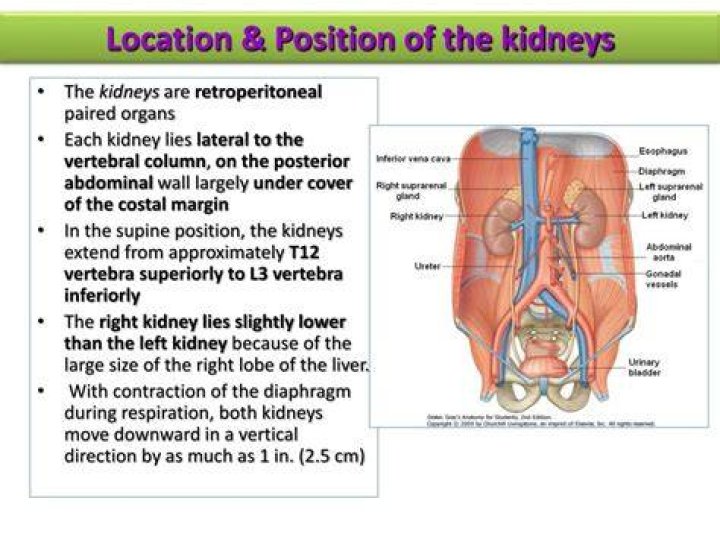
 Christopher Pierce