The voltage regulation of a transformer is defined as the rise in secondary output voltage expressed as a fraction of full load rated voltage, when full load at a specified power factor is reduced to zero (no load) keeping the primary input voltage constant..
In this way, what is the voltage regulation of an ideal transformer?
Voltage regulation of an Ideal transformer In an ideal transformer, there shall be no voltage drop in the secondary winding. Hence the voltage variation at the secondary when the load varies from full loaf to no load is zero. Therefore, for an ideal transformer, the voltage regulation is zero.
Furthermore, what is the importance of voltage regulation in transformer? Voltage regulation is the measure of how well a power transformer can maintain constant secondary voltage given a constant primary voltage and wide variance in load current. The lower the percentage (closer to zero), the more stable the secondary voltage and the better the regulation it will provide.
One may also ask, what is voltage regulation in a single phase transformer what should be its value for an ideal transformer?
When a transformer is loaded a voltage drop in primary and secondary impedances of transformer takes place. As the load current increases, this voltage drop will increase. This will reduce the secondary terminal voltage V2. The ideal value of voltage regulation of transformer is 0%.
How do you calculate percentage regulation of a transformer?
This value of phi equal to tan inverse X e q by R e q, and this value of phi equal to minus tan inverse R e q by X e q. This is how the percentage regulation of a transformer which is a measure of how much the output voltage varies depending on the load current can be plotted against load power factor angle.
Related Question Answers
Why are transformers rated in KVA?
The transformer does not alter the power factor of its output power. Transformers are rated in kVA because the losses occurring in the transformers are independent of power factor. KVA is the unit of apparent power.What is meant voltage?
Voltage, also called electromotive force, is a quantitative expression of the potential difference in charge between two points in an electrical field. An example of direct voltage is the potential difference between the terminals of an electrochemical cell.How do you measure voltage regulation?
The full-load voltage of 11.98 volts is calculated by substituting 0.001 (0.1 percent) and 12 volts into the calculation and then solving for the full-load voltage. Load regulation (percent) = 100 x (voltage no load — voltage full load) divided by voltage full load.What are the factors affecting voltage regulation?
The factors are the speed of the alternator, the quality of connections (circuit resistance), the condition of the battery and system load in the case of an automotive system. If we are talking about AC power generation, speed is critical as well as power factor for voltage regulation.What is good voltage regulation?
Voltage Regulation. The goal of good voltage regulation is to control the voltage of the system so that it will stay within a practical and safe range of voltage tolerances under all design loads. Voltage at any utilization equipment should be within the guaranteed operative range of the equipment.What is full load voltage?
Full load voltage is the voltage which we get when transformer is 100% loaded. there is a drop in voltage under loading condition for a 433v LT voltage it may drop to 425 or 420 or even 415 v.At what power factor the voltage regulation of transformer is zero?
At a certain leading power factor we get E2 = V2 and the regulation becomes zero. If the load is increased further, E2 becomes less than V2 and we get negative regulation. This is the leading p.f. at which voltage regulation becomes zero while supplying the load.What is voltage regulator and its types?
Basically, there are two types of Voltage regulators: Linear voltage regulator and Switching voltage regulator. There are two types of Linear voltage regulators: Series and Shunt. There are three types of Switching voltage regulators: Step up, Step down and Inverter voltage regulators.What are the main losses in transformer?
Iron losses, copper losses, hysteresis losses, eddy current losses, stray loss, and dielectric losses. The physical phenomenon losses occur thanks to the variation of the magnetization within the core of the transformer and also the copper loss occur because of the transformer winding resistance.What is full load in transformer?
When the transformer is operating on full load, it means maximum rated current is flowing through the secondary winding of the transformer. When the load is reduced to half, the current reduces to half, thereby reducing copper loss (which is proportional to square of current) to one-fourth of full load Cu losses.How do you find the voltage regulation of a transformer?
The voltage regulation of the transformer is the percentage change in the output voltage from no-load to full-load. And since power factor is a determining factor in the secondary voltage, power factor influences voltage regulation. This means the voltage regulation of a transformer is a dynamic, load-dependent number.What is the condition for zero voltage regulation?
'Zero voltage regulation' indicates that there is no difference between its 'no-load voltage' and its 'full-load voltage'. This means that in the voltage regulation equation above, voltage regulation is equal to zero. This is not practical – and is only theorectically possible in the case for an ideal transformer.What is regulation factor?
The voltage regulation of the transformer is the percentage change in the output voltage from no-load to full-load. And since power factor is a determining factor in the secondary voltage, power factor influences voltage regulation. This means the voltage regulation of a transformer is a dynamic, load-dependent number.What is the condition for maximum voltage regulation?
The regulation is maximum when the load power factor angle is equal to the impedance angle of the transformer. i.e., Equation (1.58) shows the power factor of the load at which voltage regulation is maximum.What is negative voltage regulation?
Negative voltage regulation can only occur with leading power factor loads; however, not all leading loads will cause negative voltage regulation. Negative voltage regulation means the voltage increases with the load. This is a very undesirable condition because it can lead to an unstable condition.What will happen if regulation of transformer is poor?
For power transformer applications, where the transformer is seen by the load as a constant source of voltage, it is good to have the secondary voltage vary as little as possible for wide variances in load current. this would be considered rather poor regulation for a power transformer.What does voltage regulation mean?
In electrical engineering, particularly power engineering, voltage regulation is a measure of change in the voltage magnitude between the sending and receiving end of a component, such as a transmission or distribution line.What is voltage drop in transformer?
In any step down transformer, the secondary current produces voltage drop across the resistive and reactive components of the transformer's secondary side. From this, it's easy to see the primary voltage will be less than the supply voltage, and the secondary (output) will be less than either of those.What is the efficiency of transformer?
Just like any other electrical machine, efficiency of a transformer can be defined as the output power divided by the input power. That is efficiency = output / input . Transformers are the most highly efficient electrical devices. Most of the transformers have full load efficiency between 95% to 98.5% . 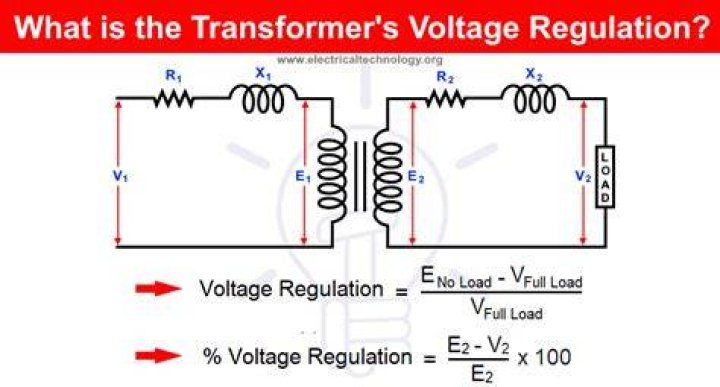
 Matthew Cannon