What is meant by Semiconservative replication?
 Ava Robinson
.
Consequently, what is meant by Semiconservative replication quizlet?
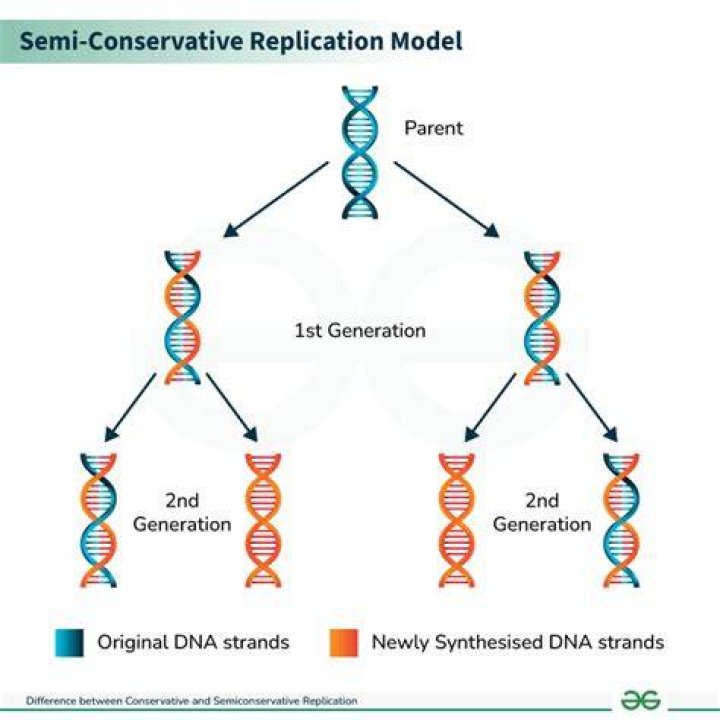
semiconservative model. type of DNA replication in which the replicated double helix consists of one old strand, derived from the old molecule, and one newly made strand. origin of replication. site where the replication of a DNA molecule begins.
Additionally, why is semi conservative replication of DNA important? The importance of the semi conservative model is that it makes sure that you have copies of the DNA that are identical to each other. Otherwise you wouldn't be able to make an exact copy of the DNA. This type of replication works thanks to DNA base pairing.
In this manner, what does Semiconservative mean in DNA?
Semi conservative literally means "Half conserved". In case of DNA , it is used for DNA replication in which one strand of DNA is conserved while other is not.
What is the function of ligase?
DNA ligase is an enzyme that repairs irregularities or breaks in the backbone of double-stranded DNA molecules. It has three general functions: It seals repairs in the DNA, it seals recombination fragments, and it connects Okazaki fragments (small DNA fragments formed during the replication of double-stranded DNA).
Related Question Answers
Which of the following is the best definition of Semiconservative replication?
Definition of semiconservative. : relating to or being genetic replication in which a double-stranded molecule of nucleic acid separates into two single strands each of which serves as a template for the formation of a complementary strand that together with the template forms a complete molecule.What is the function of topoisomerase?
Topoisomerases are enzymes that participate in the overwinding or underwinding of DNA. The winding problem of DNA arises due to the intertwined nature of its double-helical structure. During DNA replication and transcription, DNA becomes overwound ahead of a replication fork.How are Okazaki fragments formed?
Okazaki fragments form because the lagging strand that is being formed have to be formed in segments of 100–200 nucleotides. This is done DNA polymerase making small RNA primers along the lagging strand which are produced much more slowly than the process of DNA synthesis on the leading strand.What is the function of helicase in DNA replication?
helicase. Helicases are enzymes that bind and may even remodel nucleic acid or nucleic acid protein complexes. There are DNA and RNA helicases. DNA helicases are essential during DNA replication because they separate double-stranded DNA into single strands allowing each strand to be copied.Why is replication called Semiconservative quizlet?
Why it is called "semi-conservative replication of DNA"? Because half of the strands in each new DNA molecule are from the original DNA molecule. The enzyme DNA helicase breaks the hydrogen bonds between bases on the two polynucleotide DNA strands. This makes the helix unwind to form two single strands.What determines nucleotide sequence?
First, the nucleotide sequence of DNA is copied into the nucleotide sequence of single-stranded RNA in a process called transcription. Transcription of any one gene takes place at the chromosomal location of that gene. DNA has been cloned, its nucleotide sequence can be determined.What is needed for DNA replication?
New DNA is made by enzymes called DNA polymerases, which require a template and a primer (starter) and synthesize DNA in the 5' to 3' direction. DNA replication requires other enzymes in addition to DNA polymerase, including DNA primase, DNA helicase, DNA ligase, and topoisomerase.What is the benefit of Semiconservative replication?
Advantages of semi conservative replication is that during the process of DNA replication there is less of a chance of mistakes. The disadvantages are if there are mistakes during the process of DNA replication it can lead to cancer and other diseases, birth defects, and mutations.Why is it called Semiconservative replication?
1 Answer. DNA replication is called semiconservative because an existing DNA strand is used to create a new strand.How do we know DNA is Semiconservative?
Semiconservative replication would produce two copies that each contained one of the original strands and one new strand. Conservative replication would leave the two original template DNA strands together in a double helix and would produce a copy composed of two new strands containing all of the new DNA base pairs.What is the purpose of transcription?
Describe the process and purpose of transcription. The purpose of transcription is to produce an mRNA copy of a gene, to allow the genetic information to pass out of the nucleus, through the nuclear pores where it can be used to assemble a protein.What is helicase made of?
Helicases are molecular motor proteins present in viruses, bacteria, and eukaryotes [1, 2]. They harness the chemical energy of ATP hydrolysis to break the energetically stable hydrogen bonding between the duplex DNA. By doing so, helicases allow access to the genetic information locked in the duplex DNA.What two enzymes are used in DNA replication?
Enzymes involved in DNA replication are:- Helicase (unwinds the DNA double helix)
- Gyrase (relieves the buildup of torque during unwinding)
- Primase (lays down RNA primers)
- DNA polymerase III (main DNA synthesis enzyme)
- DNA polymerase I (replaces RNA primers with DNA)
- Ligase (fills in the gaps)
What are the types of DNA replication?
There were three models for how organisms might replicate their DNA: semi-conservative, conservative, and dispersive. The semi-conservative model, in which each strand of DNA serves as a template to make a new, complementary strand, seemed most likely based on DNA's structure.Who discovered Semiconservative replication?
Meselson and Stahl proved that the semiconservative model of DNA replication was correct. The following figures illustrate the Meselson and Stahl experiment which demonstrated the correctness of the semiconservative model of DNA replication.What is the first step of DNA replication?
The first step in DNA replication is the separation of the two DNA strands that make up the helix that is to be copied. DNA Helicase untwists the helix at locations called replication origins. The replication origin forms a Y shape, and is called a replication fork.What do you mean by replication?
Replication (pronounced rehp-lih-KA-shun) is the process of making a replica (a copy) of something. A replication (noun) is a copy. The term is used in fields as varied as microbiology (cell replication), knitwear (replication of knitting patterns), and information distribution (CD-ROM replication).What are the three models of DNA replication?
After Watson and Crick proposed the double helix model of DNA, three models for DNA replication were proposed: conservative, semiconservative and dispersive.- Conservative Model. In this model the two parental DNA strands are back together after replication has occurred.
- Semiconservative Model.
- Dispersive Model.