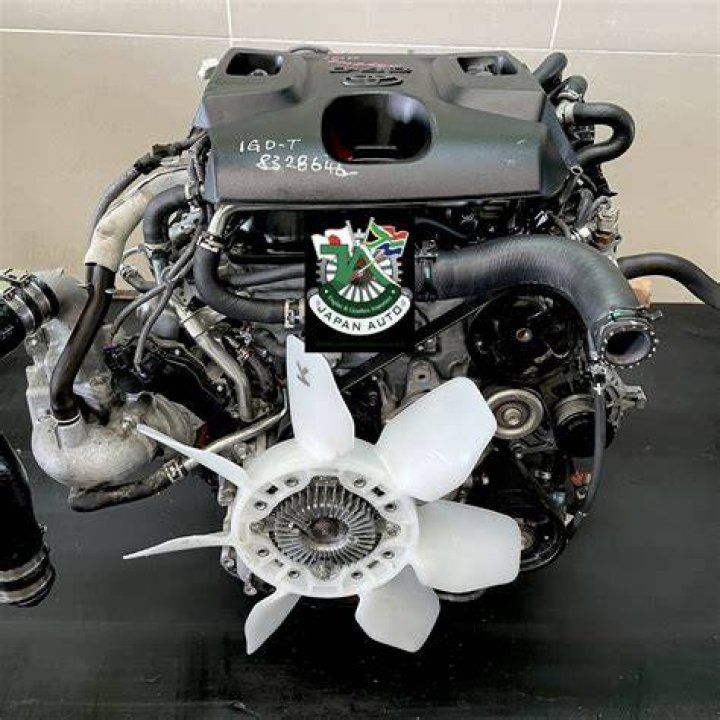
What is d4d in Toyota?
 Marcus Reynolds
 .
Accordingly, are Toyota d4d engines good?
All Replies. The D4D engines in Toyotas are excellent for reliability, and the diesels in Nissan/Renault seem to be quite good too from what I have heard. My favourite though is the engine in the S320 CDI.
Secondly, when was the d4d engine introduced? The first generation of this series of inline DOHC diesel engines was introduced in 2005.
Likewise, people ask, does a Toyota d4d have a turbo?
The Toyota D-4D Hilux, Landcruiser Prado and Hiace Van/Bus run a turbocharger with variable vanes that are electronically actuated. This 'motor' controls boost by changing the angle of vanes inside the turbo.
What is the difference between 1kd & 2kd engine?
It has two members: 1KD-FTV: The 1KD-FTV is a 3.0L (2982cc) straight-4 common rail diesel engine with a variable geometry turbocharger and Intercooler. 2KD-FTV: The 2KD-FTV is the 2nd generation of the KD series of engine with a smaller 2.5 L (2494 cc) displacement.
Related Question Answers
Who makes the most reliable diesel engines?
The most reliable diesel cars are made by Skoda, with a failure rate of just 9 per cent. Alfa Romeo, Land Rover, Kia and Mazda diesels have the highest average diesel engine repair cost versus petrol counterparts.How many miles will a Toyota Hilux do?
387,000 miles
What is the best diesel car engine?
The best diesel enginesThe 120 KM 8v is the most recommended of its versions; it is dynamic and economical. This 1.9 JTD engine can be found in Alfa Romeo, Fiat, Lancia, Opel (CDTI), Saab, Suzuki and Cadillac. The BMW 3.0d engine is like wine: the older, the better.Are small diesel engines reliable?
Some small displacement car diesels are very good, but remain to be seen if they will last 200,000+ miles and still be in good shape. Ford, Nissan, Honda, Toyota, BMW, VW, Puegot and Fiat all have sub 2.0L engines that could prove to be very good and be long lasting engines.Are Toyota Avensis reliable?
Toyota has an excellent reputation for reliability and the Avensis boasts a strong track record in this department. It comes with a five-year warranty, too, which should help to alleviate any doubts that may have been created by the high profile recalls that have hit Toyota's brand in recent years.Are PSA engines reliable?
While Peugeot models have some issues, overall their cars and the brand as a whole are very dependable. Their reliability indexes for their most popular cars are low, though their repair costs can be quite expensive. However, they are still not as expensive as some of their rivals.Are Honda diesel engines reliable?
Honda diesel engines although not as smooth as Hyundai diesel engines, but are design, economy, metallurgy and longevity wise, far more superior and Reliable.Who makes Renault diesel engines?
The K9K is a family of straight-4 turbocharged diesel engines co-developed by Nissan and Renault.What is VN Turbo?
Variable-geometry turbochargers (VGTs), occasionally known as variable-nozzle turbines (VNTs), are a type of turbochargers, usually designed to allow the effective aspect ratio of the turbocharger to be altered as conditions change.How does a turbo stepper motor work?
The Electronic Actuator Stepper Motor on turbochargers move the vanes inside a VNT (Variable Nozzle Technology) turbo. The variable vanes do the same job as a dump valve on a standard pneumatic-actuated turbo. That is, they allow boost and release of gasses via vane movement, facilitated by nozzle ring movement.How does a turbo electronic actuator work?
Turbocharger Actuators. Pneumatic actuators work from the air pressure in the inlet manifold. When it gets to a preordained limit the actuator opens and allows some exhaust gas to pass or waste away from the turbine wheel. Slowing down the turbocharger speed and boost.What does gd6 stand for?
Trivia Box: What Does GD-6 Stand For? GD stands for “Global Diesel“, a brand new range of Toyota diesel engines. The hallmark of the GD engine series is fuel efficiency and advanced thermal combustion technology.What is meant by VVTI engine?
VVT-i, or Variable Valve Timing with intelligence, is an automobile variable valve timing technology developed by Toyota. The Toyota VVT-i system replaces the Toyota VVT offered starting in 1991 on the 5-valve per cylinder 4A-GE engine. The VVT system is a 2-stage hydraulically controlled cam phasing system.What is the difference between 3l and 5l engine?
The 3L is a 2.8 l engine and the 5L is a 3.0 l. Both non-turbo and indirect injection. The 3L is a 2.8 l engine and the 5L is a 3.0 l. Both non-turbo and indirect injection.What does 2.5 mean in cars?
It's actually 2.5 L. This referes to the total displacement of the engine in liters. Essentially, this indicates the maximum combined volume of all of the cylinders of the engine, at the highest draw of the piston's stroke. Displacement is also commonly measured in Cubic Centimeters, or CCs.Are Prado and HiLux engines the same?
While both make similar maximum power (126kW for the HiLux and 127kW for the Prado), the Prado has a higher maximum torque output (410Nm versus 343Nm). But the difference is not as much as you might think, as the HiLux is some 300kg lighter than the Prado.What engine is in a Toyota HiLux?
The Toyota Hilux has three engines available, and the Toyota Tacoma has two. In the Hilux, you can get two different diesel engines or one gas engine, all of which are 4-cylinders. The base engine is a 2.4-liter turbodiesel that produces up to 150 horsepower and 300 lb-ft of torque.What is a 5l engine?
5L. The 5L is a 3.0 L (2,986 cc) four-cylinder diesel engine. Bore and stroke is 99.5 mm × 96 mm (3.92 in × 3.78 in), with a compression ratio of 22.2:1.When did the d4d Prado come out?
November 1984