They are filter feeders, meaning they feed by pushing water through its pores. They have organelles called flagella, which help push the water through as well as filtering out particles from the water, which then serves as nutrients for the sponge. Multicellular organisms that are found in oceans all over the world..
Herein, what is the ecological role of cnidarians?
Cnidaria: Life History and Ecology Other cnidarians are important as predators in the open ocean. Cnidarians generally occupy two major niches. They may use their cnidocysts to trap prey items. Some cnidarians are nearly completely dependent on zooxanthellae; others trap prey but augment their diet with zooxanthellae.
Also, how do sponges and cnidarians exchange gases with the environment? The gastrovascular cavity has only one opening that serves as both a mouth and an anus (an incomplete digestive system). Like the sponges, Cnidarian cells exchange oxygen, carbon dioxide, and nitrogenous wastes by diffusion between cells in the epidermis and gastrodermis with water.
Also know, what is the difference between sponges and cnidarians?
Sponges have specialized cells and an endoskeleton, but they lack tissues and body symmetry. Many live on coral reefs and have symbiotic relationships with other reef species. Cnidarians are aquatic invertebrates in Phylum Cnidaria. They include jellyfish and corals, both of which have radial symmetry.
What is the function of a Nematocyst?
The functions of nematocysts are to attack predators. Nematocysts are small stinging cells that are located on the tentacles of jellyfish.
Related Question Answers
How do cnidarians benefit humans?
The Cnidarians include the hydroids, jellyfish, anemones, and corals. All Cnidarians have tentacles with stinging cells in their tips which are used to capture and subdue prey. Most Cnidarian's nematocysts are not harmful to humans, as the stinger cannot penetrate sufficiently into human skin to inflict any harm.How do cnidarians impact humans?
All cnidarians have the potential to affect human physiology owing to the toxicity of their nematocysts. These, and even normally innocuous species, can be deadly in a massive dose or to a sensitive person, but the only cnidarians commonly fatal to humans are the cubomedusae, or box jellyfish.What are the economic importance of Coelenterates?
They provide an important habitat for a huge number of commercially fished species, including crustaceans and other invertebrates, fish, algae, seaweed and more. These coral reefs also have a huge economic impact due to tourism as well, as people flock to the reefs for snorkeling, diving and other activities.How do cnidarians reproduce?
Reproduction of CnidariansMedusae usually reproduce sexually using eggs and sperm. Cnidarians switch from the polyp to the medusa stage by a form of asexual reproduction in which the polyp develops a stack of medusoid structures that can then bud off to become independent medusae.Why are coral reefs important to humans?
Functions of Coral Reefs: Coral reefs are important for many different reasons aside from supposedly containing the most diverse ecosystems on the planet. They: protect coastlines from the damaging effects of wave action and tropical storms. provide habitats and shelter for many marine organisms.When did cnidarians first appear?
580 million years ago
What do cnidarians eat?
Many Cnidarians eat small planktonic animals that they catch with their tentacles and stinging nematocysts. They don't go "hunting" but have to wait for their prey to blunder into the tentacles. Once this has happened other tentacles are brought to the prey to secure capture and subdue it with more stinging cells.Are cnidarians beneficial to man?
Importance to HumansAll cnidarians have the potential to affect human physiology owing to the toxicity of their nematocysts. Most are not harmful to humans, but some can impart a painful sting—such as Physalia, the Portuguese man-of-war, and sea anemones of the genus Actinodendron.How do sponges reproduce?
Sponges may reproduce sexually and asexually. After fertilization in the sponge, a larva is released into the water. It floats around for a few days and then sticks to a solid to begin its growth into an adult sponge. Sponges are also able to reproduce asexually through budding.How do sponges eat?
Diet: Sponges are filter feeders. Most sponges eat tiny, floating organic particles and plankton that they filter from the water the flows through their body. Food is collected in specialized cells called choanocytes and brought to other cells by amoebocytes.What are the three body layers of a sponge?
Body types: Sponges have three body types: asconoid, syconoid, and leuconoid. Asconoid sponges are tubular with a central shaft called the spongocoel. The beating of choanocyte flagella force water into the spongocoel through pores in the body wall. Choanocytes line the spongocoel and filter nutrients out of the water.How do sponges and cnidarians get food?
compare and contrast how sponges and cnidarians get their food. Sponge- the filtered water carries away wastes through an opening in the top of the sponge. Cnidarians- tentacles bring the prey to the mouth and then it ingests the food.What type of body plan do sponges have?
Asconoid. The most simplistic body plan within the phylum porifera is the asconoid body plan. This is such a simplistic structure because the body plan has only one large internal chamber, called a spongocoel, that is lined with water-filtering choanocyte cells.What are the two cell layers in sponges?
Sponges are made up of two layers of cells, and ectoderm / epidermis and an endoderm, with a jellyish but non-cellular layer between.What separates sponges from all other animals?
Sponges are similar to other animals in that they are multicellular, lack cell walls, and produce sperm cells. Unlike other animals, they lack true tissues and organs, and have no body symmetry. All sponges lack the ability to move.What feature of all cnidarians gives them their name?
What feature of all cnidarians gives them their name? The word cnidaria translates to “stinging animal”, thus they get their name from the fact that they sting their prey or use it as a self-defense mechanism.Are Hydranths or Gonangia more numerous?
It is fastened to the substratum by a root-like base, called hydrorhiza. The polyps are of two kinds: hydranths and blastostyles. ADVERTISEMENTS: The hydranths are more numerous and constitute the feeding zooids.How do sponges get rid of co2?
These canals exist to move water through the sponge's body. Lining these canals are special collar cells. The collar cells force water through the sponge which brings oxygen and nutrients while removing carbon dioxide and waste.Do sponges move?
Although many sponges actually move less than a millimetre a day, some adult sponges are actually sessile, which means that they are fixed onto something and do not move at all. Most sponges live in a salt water environment, attached to objects on the sea floor. 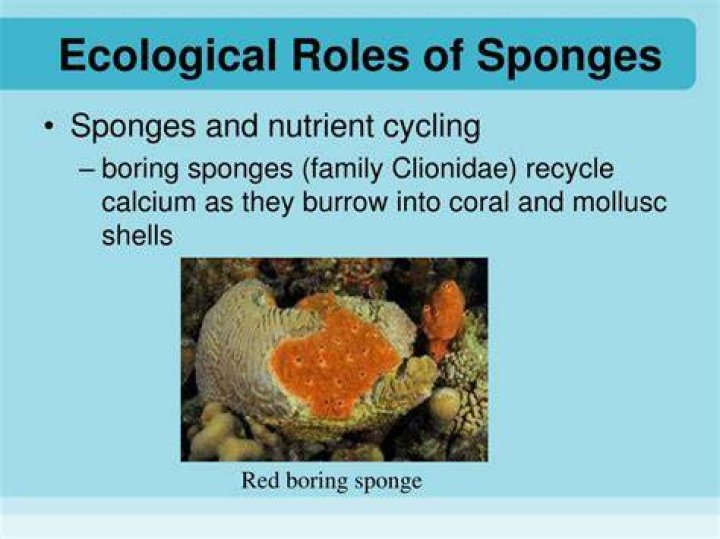
 Mia Fernandez