Xylem tissue is used mostly for transporting water from roots to stems and leaves but also transports other dissolved compounds. Phloem is responsible for transporting food produced from photosynthesis from leaves to non-photosynthesizing parts of a plant such as roots and stems..
In this manner, what are the functions of phloem?
Phloem is the vascular tissue responsible for the transport of sugars from source tissues (ex. photosynthetic leaf cells) to sink tissues (ex. non-photosynthetic root cells or developing flowers). Other molecules such as proteins and mRNAs are also transported throughout the plant via phloem.
Additionally, what is the function of xylem and phloem quizlet? Xylem tissue transports water and mineral ions, phloem tissue transports dissolved substances like sugars. Xylem and phloem are found throughout the plant (they transport materials to all parts).
Considering this, what are functions of xylem?
The basic function of xylem is to transport water from roots to stems and leaves, but it also transports nutrients. The word "xylem" is derived from the Greek word ξύλον (xylon), meaning "wood"; the best-known xylem tissue is wood, though it is found throughout a plant.
What is the difference between xylem and phloem?
While, the movement of phloem is bidirectional, which is the inverse of the xylem. The difference between them are as follows: Xylem transports minerals and water from roots to upper parts of the plant. Phloem transports nutrients and food like amino acids, sugars from leaves to growing parts of the plant.
Related Question Answers
What are the types of phloem?
Phloem is the vascular tissue in charge of transport and distribution of the organic nutrients. The phloem is also a pathway to signaling molecules and has a structural function in the plant body. It is typically composed of three cell types: sieve elements, parenchyma, and sclerenchyma.What is an example of phloem?
Phloem is the tissue in plants that transport food to the parts of the plant where it needs to go. An example of the phloem is the tissue in plants that distributes the sugar that plants eat. YourDictionary definition and usage example.Why is phloem important?
The xylem and the phloem make up the vascular tissue of a plant and transports water, sugars, and other important substances around a plant. Phloem is responsible for transporting food produced from photosynthesis from leaves to non-photosynthesizing parts of a plant such as roots and stems.Where is phloem located?
Phloem parenchyma cells, called transfer cells and border parenchyma cells, are located near the finest branches and terminations of sieve tubes in leaf veinlets, where they also function in the transport of foods. Phloem fibres are flexible long cells that make up the soft fibres (e.g., flax and hemp) of commerce.What are the components of phloem?
Answer : Phloem is made up of four types of elements: Sieve tubes, companion cells, phloem fibres and the phloem parenchyma.Who discovered phloem?
In 1837, the forest botanist Hartig discovered the SE using bright-field light microscopy. In a publication addressing the progress that had been made in phloem research until 1956, Cheadle wrote: 'Truly the field of phloem anatomy is a wide open one.What is cambium and its function?
What Does the Cambium Do? The main job of the cambium is to promote growth of secondary xylem and phloem. It's located directly between the primary xylem and phloem in a circular layer. Typically, dicot plants or gymnosperms have cambium tissue. A dicot is a plant that has two embryonic leaves at germination.What is the definition of phloem in biology?
A tissue in vascular plants that conducts food from the leaves and other photosynthetic tissues to other plant parts. Phloem consists of several different kinds of cells: sieve elements, parenchyma cells, sclereids, and fibers. See more at cambium photosynthesis.What are the four components of xylem?
??The main constituents of xylem are xylem tracheid, vessels and xylem parenchyma. ??Here the main components are sieve tubes, companion cells and phloem parenchyma. ➖Xylem and Phloem consists of four different types of cells.What are the types of xylem?
Xylem can be defined as a complex tissue that is composed of four basic types of cell (tracheids, trachea, and xylem fibre and xylem parenchyma), remains in close association with phloem and has specialized functions like conduction of water and solutes, and mechanical strength.What is Xylem in biology?
xylem. [ zī′l?m ] A tissue in vascular plants that carries water and dissolved minerals from the roots and provides support for softer tissues. Xylem consists of several different types of cells: fibers for support, parenchyma for storage, and tracheary elements for the transport of water.Which cells of xylem are living?
The most distinctive xylem cells are the long tracheary elements that transport water. Xylem also contains two other cell types: parenchyma and fibers. Xylem parenchyma is the only living component of the xylem tissue. Rest all (tracheids, vessels and xylem fibres) are dead.Where is xylem found?
Xylem is located in roots, stems and leaves of the plant and it transports water and minerals from plant roots to aerial parts. With phloem it forms vascular bundles. Dead cells in Xylem contribute to wooden parts of the plant.What is the structure and function of xylem?
Xylem Structure and Function. Xylem is the specialised tissue of vascular plants that transports water and nutrients from the plant–soil interface to stems and leaves, and provides mechanical support and storage. The water-conducting function of xylem is one of the major distinguishing features of vascular plants.What is Xylem made of?
Xylem tissue consists of a variety of specialized, water-conducting cells known as tracheary elements.Why are xylem cells dead?
Xylem is a tissue consisting of dead, hollowed-out cells that form a system of pipes. The walls of xylem cells are lignified (strengthened with a substance called lignin ). This allows the xylem to withstand pressure changes as water moves through the plant.What is cambium cells?
Cambium, plural Cambiums, orCambia, in plants, layer of actively dividing cells between xylem (wood) and phloem (bast) tissues that is responsible for the secondary growth of stems and roots (secondary growth occurs after the first season and results in increase in thickness).In what leaf structures are the xylem and phloem located?
In leaves, the vascular bundles are located among the spongy mesophyll. The xylem is oriented toward the adaxial surface of the leaf (usually the upper side), and phloem is oriented toward the abaxial surface of the leaf.What makes stomata open?
Structure of stomataStomata are composed of two guard cells. These cells have walls that are thicker on the inner side than on the outer side. This unequal thickening of the paired guard cells causes the stomata to open when they take up water and close when they lose water. 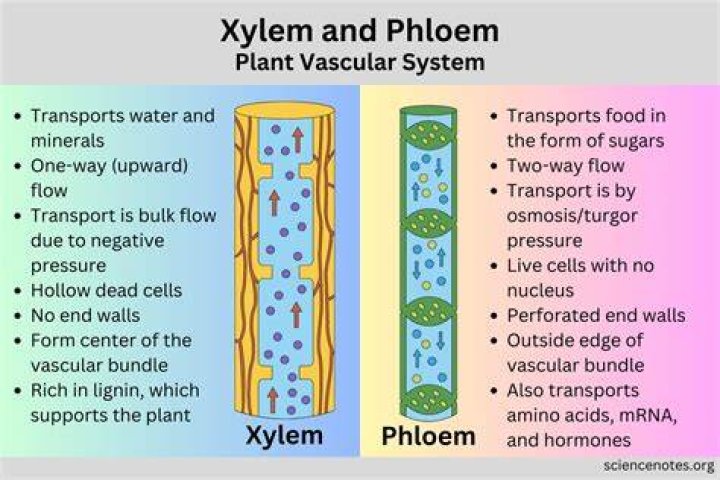
 Ava Robinson