How do you calculate lifetime value of LTV?
 Madison Flores
 .
Also question is, how do you calculate lifetime value?
To calculate customer lifetime value you need to calculate average purchase value, and then multiply that number by the average purchase frequency rate to determine customer value. Then, once you calculate average customer lifespan, you can multiply that by customer value to determine customer lifetime value.
One may also ask, what is the formula for calculating CLV? The calculation of CLV (WITH discounting) would be:
- Year 0 = – $1,000 acquisition costs divided by 1 (no discount)
- Year 1 = $1,000 customer profit divided by 1.1 (10% discount) = $909.
- Year 2 = $1,500 customer profit X 75% retention divided by 1.21 (10% X 10% discount) = $930.
Also, how do I calculate my LTV subscription?
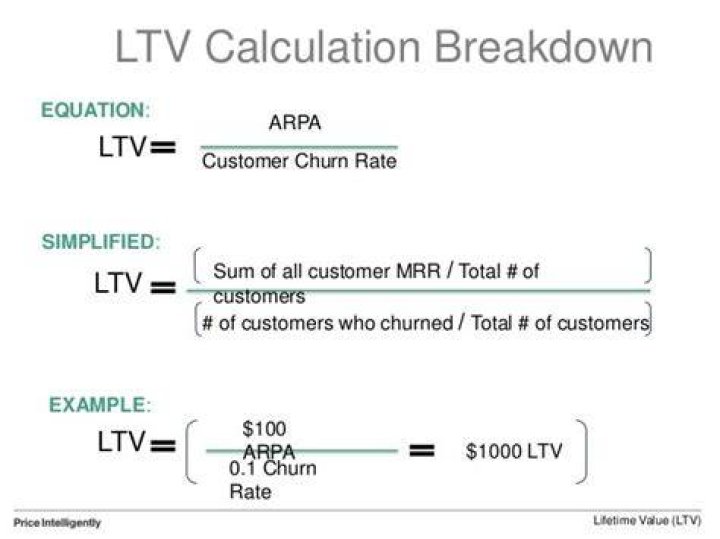
How To Calculate LTV. Lifetime Value can be calculated in many ways. In the case of a subscription model, a simple method is to take the average monthly amount expected from each customer and divide it by your churn rate (the rate at which you lose customers each month).
How do you calculate LTV in marketing?
In the simplest form, LTV equals Lifetime Customer Revenue minus Lifetime Customer Costs. Using a simple example, if a customer purchases $1,000 worth of products or services from your business over the lifetime of your relationship, and the total cost of sales and service to the customer is $500, then the LTV is $500.
Related Question Answers
What is the CLV formula?
The Simple CLV FormulaThe most basic way to determine CLV is to add up the revenue earned from a customer (annual revenue multiplied by the average customer lifespan) minus the initial cost of acquiring them.What is a good LTV?
An LTV ratio of 80% or lower is considered good for most mortgage loan scenarios. An LTV ratio of 80% provides the best chance of being approved, the best interest rate, and the greatest likelihood you will not be required to purchase mortgage insurance.What is a good lifetime value?
As long as your customer lifetime value (CLTV) is moderately higher than your customer acquisition cost (CAC), then you're good. That means that the value of your customers should be three times more than the cost of acquiring them. If the ratio is 1:1, then that means your spending too much on acquiring customers.What is customer lifetime value CRM?
CRM and CLV: Customer Lifetime ValueThat's why Customer Lifetime Value (CLV) metrics exist. The Marketing Accountability Standards Board (MASB) defines it as the “value of the future cash flows attributed to the customer during the entire relationship with the company.”What is AOV?
AOV is an acronym for Average Order Value. AOV is an essential key performance indicator (KPI) for eCommerce websites. AOV can be found and monitored as a KPI in most common eCommerce web analytics dashboards, making it easy for businesses to monitor merchandise performance related to customer orders.Why is CLV important?
Customer lifetime value is important because, the higher the number, the greater the profits. You'll always have to spend money to acquire new customers and to retain existing ones, but the former costs five times as much. When you know your customer lifetime value, you can improve it.What is my CLV?
CLV = Lifetime Customer Revenue – Lifetime Customer CostsCLV helps you to calculate the amount of revenue you can expect to generate from one customer during the tenure of their relationship with your business. Here is the most simple way to calculate your CLV.How do you calculate churn LTV?
LTV = ARPU / User ChurnThe higher your user churn, the lower your LTV will be. You can see why paying attention to both LTV and churn is so critical.What is LTV used for?
The loan-to-value (LTV) ratio is a financial term used by lenders to express the ratio of a loan to the value of an asset purchased. The term is commonly used by banks and building societies to represent the ratio of the first mortgage line as a percentage of the total appraised value of real property.Is LTV revenue or profit?
1. Using revenue instead of profits. Using revenue instead of profit to calculate your LTV can dramatically overvalue customers, leading you to believe you can spend far more to acquire them than is actually sustainable. However, LTV should always be a measure of profit, not revenue.How do you calculate value?
Time Value of Money Formula- FV = the future value of money.
- PV = the present value.
- i = the interest rate or other return that can be earned on the money.
- t = the number of years to take into consideration.
- n = the number of compounding periods of interest per year.
How do you increase your LTV?
Here's a straightforward way to improve LTV by creating multiple engagement points.- Make a list of the places where your customers spend time, both online and offline.
- Develop an advertising or content marketing presence in those places.
- Encourage your customers to engage with your brand on those platforms.
How is ARPA calculated?
ARPA is calculated by dividing your total monthly recurring revenue (MRR) by the total number of accounts. This can easily be converted to a yearly metric by replacing the MRR with annual recurring revenue (ARR). There are two other types of ARPA: new and existing.How do you calculate startup LTV?
Startup Metric #4 Life Time Value (LTV)It could be six months, 12 months or longer. Then you multiply the monthly revenue you expect from that customer and you get the LTV. Keep in mind that you should include any expenses related to installation or maintenance of your product.What is a good LTV to CAC ratio?
3:1
How do you determine the value of a product?
One approach is to use the simple equation Value = Benefits / Cost. The plus side to this approach is that it is concrete and quantifiable. You can measure the profit consistently throughout the life of the product, charting changes in value over time.How do you calculate the value of a customer list?
Once you determine the annual average cost to get a customer across all media, it is simple to multiply that average cost by the number of buyers to put a value on your customer list. Example: Your company has 100,000 buyers, and it costs you $10 on average to get a customer.How do you measure customer value?
Here are 8 ways CMOs can measure the value of their customers:- Historic. Look at what that customer has done in the past with your brand in terms of purchases, but also follow when and how frequently they have purchased from you.
- Future.
- Lifetime.
- Influence.
- Frequency.
- Purchase Amount.
- Interaction.
- Loyalty.