Explanation: Atmospheric pressure is dependent on two things, water content and temperature. Therefore as your latitude increases the pressure drops. This drop in pressure also results in a drop in the heights of the different levels of the atmosphere..
Likewise, people ask, does atmospheric pressure change with seasons?
The fall and winter seasons had the highest variability in atmospheric pressure readings. There was a significant correlation (p = 0.0083) between a decrease in atmospheric pressure and the occurrence of AMI the day after a pressure decrease, especially during the fall and winter seasons.
Furthermore, why does atmospheric pressure depend on your location? Atmospheric pressure is not the same everywhere on Earth. Atmospheric pressure depends on the altitude (or height) of your location. The higher up we go, the less air pressure we will encounter. For example, Denver, Colorado is about 1.6 kilometers (1 mile) above sea level.
Beside above, how does the atmospheric pressure change with altitude?
Pressure with Height: pressure decreases with increasing altitude. The pressure at any level in the atmosphere may be interpreted as the total weight of the air above a unit area at any elevation. At higher elevations, there are fewer air molecules above a given surface than a similar surface at lower levels.
Which latitudes have high atmospheric pressures?
There are surface belts of low pressure at the equator (the equatorial low) and at 60 degrees latitude (the subpolar low). There are belts of high pressure (the subtropical high) at 30 latitude and high pressure centers at the two poles (the polar highs).
Related Question Answers
Why do I feel so tired when the weather changes?
In the winter, we're busy producing more of the sleep hormone melatonin. But when spring comes along, our bodies react to the increased levels of light and release more serotonin, the activity hormone. The change can be a heavy burden on the body, causing us to feel more tired for a few weeks as we adjust.What happens when atmospheric pressure increases?
Changes in atmospheric pressure often, but not always, predict the weather in coming days. Falling pressure suggests that a low-pressure zone with wet, stormy weather is moving your way. Rising barometric pressure is often, though not always, a sign that the weather will soon clear and turn fair and sunny.In which season air pressure is lowest?
Answer and Explanation:Air pressure is lowest during the summer season when the temperature is hottest. This is because warm air is less dense than cold air, as the heatWhat is a comfortable barometric pressure?
Vanos said people are most comfortable with barometric pressure of 30 inches of mercury (inHg). When it rises to 30.3 inHg or higher, or drops to 29.7 or lower, the risk of heart attack increases.What is the current atmospheric pressure?
Average sea-level pressure is 1013.25 mbar (101.325 kPa; 29.921 inHg; 760.00 mmHg).What instrument measures air pressure?
barometer
What is the relationship between air pressure and temperature?
The relationship between the two is that air temperature changes the air pressure. For example, as the air warms up the molecules in the air become more active and they use up more individual space even though there is the same number of molecules. This causes an increase in the air pressure.What are the factors affecting air pressure?
Factors Affecting Air Pressure: - Temperature: As the temperature increases, air expands because of which its density decreases which results in low pressure.
- Height from Sea Level:
- Moisture in Air (Humidity):
- Gravitation of Earth:
- Rotation of Earth:
What is the difference between air pressure and atmospheric pressure?
Air pressure is what you measure with a tire gauge. Atmospheric pressure is what you measure with a mercury barometer. Pressure is the amount of force per unit area that a gas exerts on a surface. If the pressure on both sides of the surface are equal then the relative pressure is zero.What is considered high atmospheric pressure?
Well, at sea level, the average barometric pressure should be somewhere around 1.013 * 10^5 Pa, or around 1,013 millibars, or 29.92 inches of Mercury. “High pressure” basically means “above-average pressure.” When you're above 1,013 millibars, you're generally approaching high pressure systems.Why is air pressure highest at sea level?
The higher the altitude, the lower the air pressure. This is because the number of air molecules decreases at higher altitudes, thus decreasing air density and air pressure. Air pressure is highest at sea level, where air density is greatest.What is normal atmospheric pressure in ATM?
Normal atmospheric pressure is 14.7 psi, which means that a column of air one square inch in area rising from the Earth's atmosphere to space weighs 14.7 pounds. Normal atmospheric pressure is defined as 1 atmosphere. 1 atm = 14.6956 psi = 760 torr.At what barometric pressure does it rain?
If the reading is under 29.80 (100914.4 Pa or 1009.144 mb):Rising or steady pressure indicates clearing and cooler weather. Slowly falling pressure indicates rain. Rapidly falling pressure indicates a storm is coming.What is atmospheric pressure in simple words?
That pressure is called atmospheric pressure, or air pressure. It is the force exerted on a surface by the air above it as gravity pulls it to Earth. Atmospheric pressure is commonly measured with a barometer. One atmosphere is 1,013 millibars, or 760 millimeters (29.92 inches) of mercury.Does atmospheric pressure affect weight?
Later: Air density if affected by air pressure as well as temperature and humidity, so atmospheric pressure (which you asked about) affects weight measurements, but not directly. Weight is the force exerted by the earth (or some other celestial body if you're considering weight in a different place) on a mass.How does pressure vary with temperature?
Gay-Lussac's Law is one part of the ideal gas law and so explains how gases change when volume is held constant. As the temperature increases, the molecules in the gas move faster, impacting the gas's container more frequently and exerting a greater force. This increases the pressure.How do you measure air pressure?
An instrument that measures air pressure is called a barometer. One of the first barometers was developed in the 1600s. The original instrument had mercury in the small basin, with an upside down glass tube placed in the mercury. As air pressure increased, the pressure would force more mercury in the tube.How does atmospheric pressure affect humans?
Barometric pressure is the weight of the atmosphere that surrounds us. Barometric pressure often drops before bad weather. Lower air pressure pushes less against the body, allowing tissues to expand. Expanded tissues can put pressure on joints and cause pain.What is the importance of atmospheric pressure?
Why is Barometric Pressure Important? Barometric pressure has important effects on water chemistry and weather conditions. It affects the amount of gas that can dissolve in water. More gas, such as oxygen, can dissolve in water under higher pressure when compared to lower air pressure. 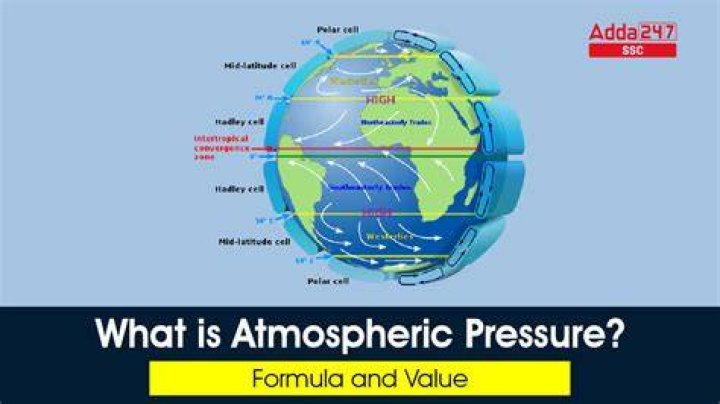
 Emma Jordan